Xiamen Tmax Battery Equipments Limited was set up as a manufacturer in 1995, dealing with Laboratory equipments, technology, etc. We have total manufacturing facilities of around 2, 000 square meters and more than 100 staff. Owning a group of experie-nced engineers and staffs, we can bring you not only reliable products and technology, but also excellent services and real value you will expect and enjoy.
Microwave Ashing Furnace: A HighEfficiency Solution for Rapid and Accurate Ash Determination
The Microwave Ashing Furnace is a specialized analytical and thermalprocessing device designed for rapid, controlled, and highly accurate ashing of organic and inorganic materials. By integrating microwave heating technology with advanced thermal engineering, this furnace enables laboratories and industrial facilities to drastically reduce ashing time while maintaining exceptional reproducibility and compliance with analytical standards.
Unlike conventional muffle furnaces that rely solely on radiant and convective heating, the microwave ashing furnace employs microwave dielectric heating to excite polar molecules within the sample. When subjected to microwave frequencies—typically 2.45 GHz—these molecules oscillate rapidly, generating heat uniformly throughout the sample mass. This volumetric heating mechanism significantly accelerates oxidation processes, enabling ashing cycles that are often five to ten times faster than traditional methods. For laboratories requiring high throughput and precise analytical results, this advantage is transformative.
A typical microwave ashing furnace consists of several key engineered components. The system begins with a microwave generation module, commonly powered by a magnetron or solidstate microwave source, capable of delivering stable power outputs across a range of programmable intensities. The electromagnetic energy is transmitted through a carefully tuned waveguide network, ensuring efficient and uniform distribution across the ashing chamber. Many designs incorporate field homogenization structures, such as mode stirrers or reflective cavity geometries, to minimize hot spots and maximize thermal uniformity.
The ashing chamber itself is constructed from microwavetransparent, hightemperatureresistant materials such as quartz or advanced ceramics. These materials permit effective microwave penetration while withstanding oxidation temperatures commonly reaching 600–1000°C, depending on the model and application. To withstand these elevated temperatures, the furnace integrates auxiliary radiant heating elements that supplement microwave energy during the final stages of ashing. This hybrid heating approach ensures complete combustion of carbonaceous material and full compliance with established analytical methodologies, including ASTM, ISO, and EPA procedures.
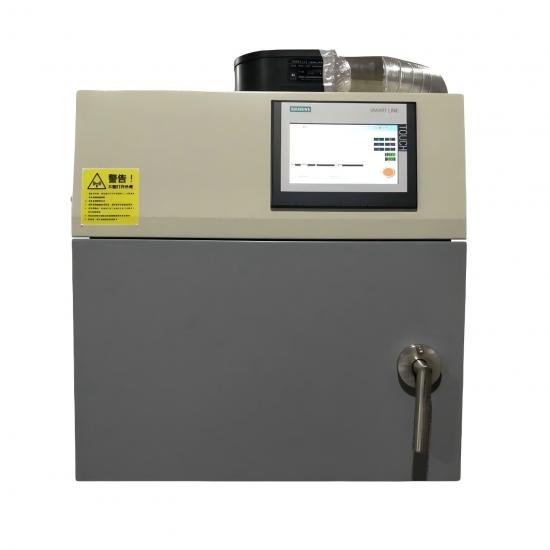
1100C Microwave Furnace
A defining feature of the microwave ashing furnace is its sophisticated temperature and processcontrol system. Utilizing infrared temperature sensors, fiberoptic probes, and microprocessorbased controllers, the furnace maintains precise thermal regulation throughout the ashing cycle. These systems enable programmable multistage heating profiles, automatic adjustment of microwave power, and timed oxidation sequences. As a result, laboratories benefit from consistent, repeatable results even when processing complex or moisturerich samples.
Safety engineering plays a critical role in the design of the microwave ashing furnace. Because the ashing process generates fumes, particulates, and potentially corrosive byproducts, the furnace is equipped with an integrated exhaust and filtration system. This system captures and neutralizes emissions before they are released into the laboratory environment. Additionally, electromagnetic shielding, sealed chamber architecture, and door interlock mechanisms ensure zero microwave leakage and fully protected operation. Overtemperature protection, airflow monitoring, and hardware fault detection further enhance system reliability and user safety.
In practical applications, the microwave ashing furnace is widely used in food and feed analysis, pharmaceutical quality control, environmental testing, coal and mineral analysis, and polymer and plastics characterization. Its ability to deliver rapid, complete ashing makes it ideal for determining ash content, volatile components, inorganic residues, and combustion behavior across a broad range of materials. Industries benefit from shortened analysis cycles, reduced energy consumption, lower labor costs, and highly precise analytical outcomes.
In conclusion, the Microwave Ashing Furnace represents an advanced, highperformance solution for laboratories seeking rapid, accurate, and reliable ashing capabilities. Its combination of microwave technology, precision thermal control, robust safety design, and versatile application range makes it an essential tool for modern analytical sciences and industrial quality assurance.