Xiamen Tmax Battery Equipments Limited was set up as a manufacturer in 1995, dealing with Laboratory equipments, technology, etc. We have total manufacturing facilities of around 2, 000 square meters and more than 100 staff. Owning a group of experie-nced engineers and staffs, we can bring you not only reliable products and technology, but also excellent services and real value you will expect and enjoy.
Microwave Tube Furnace: Advanced Thermal Processing Equipment for Precision Materials Engineering
A microwave tube furnace is an innovative thermal processing system that integrates microwave heating technology with a sealed tubular chamber for precise and efficient heat treatment of advanced materials. This equipment is widely used in laboratories, research institutions, and industrial production lines for applications such as sintering, calcination, pyrolysis, catalyst preparation, nanomaterial synthesis, and high-purity atmosphere processing. Its combination of controlled heating, rapid thermal response, and flexible atmosphere management makes the microwave tube furnace a crucial tool for modern materials engineering.
1. Working Principle of Microwave Tube Furnace
The microwave tube furnace operates using electromagnetic waves—typically at 2.45 GHz or 915 MHz—to heat materials through dielectric loss. Unlike conventional mechanisms that transfer heat via conduction or convection, microwave energy directly interacts with the material, causing molecules and ions to oscillate and generate internal heat. This volumetric heating effect leads to faster temperature rise, enhanced thermal uniformity, and reduced energy consumption.
The furnace features a tubular chamber made from high-temperature materials such as quartz, alumina, or silicon carbide. This tube provides a fully enclosed environment where gases can be introduced, evacuated, or controlled for sensitive chemical reactions. A microwave cavity surrounds the tube, ensuring efficient energy penetration without contamination.
Key structural components include:
* Microwave generators and waveguides
* High-strength thermal insulation
* Quartz or ceramic tube
* Temperature control system with thermocouples
* Gas inlet/outlet ports and vacuum interface
* Safety interlock mechanisms
This integrated design allows for highly repeatable and precise thermal processes.
2. Engineering Advantages of Microwave Tube Furnaces
Rapid and Uniform Heating
Microwave volumetric heating ensures that energy interacts directly with the sample, enabling rapid temperature changes and minimizing internal thermal gradients. This is especially important for materials prone to cracking or deformation.
Lower Processing Temperatures
Microwave-assisted reactions often require significantly lower temperatures compared to conventional furnaces. Enhanced molecular activation reduces sintering temperatures and accelerates chemical transformations.
Atmosphere Flexibility
A microwave tube furnace supports a variety of processing gases, including:
* Inert atmospheres (argon, nitrogen, helium)
* Reducing gases (hydrogen, forming gas)
* Oxidizing gases (oxygen, air)
* Vacuum conditions for contamination-free processing
This versatility makes the equipment suitable for sensitive materials and catalyst development.
Energy Efficiency
Microwave heating reduces energy consumption by 30–60% depending on material characteristics. Since heat is generated inside the sample, very little energy is wasted compared to standard resistance furnaces.
Precise Temperature Control
Advanced PID controllers, digital interfaces, and multi-zone temperature control systems ensure stable, repeatable heating profiles with high accuracy.
Compact and Clean Operation
Microwave tube furnaces occupy less space, generate less heat waste to the surroundings, and offer near-cleanroom compatible operation with minimal contamination risk.
3. Applications Across Advanced Material Industries
The microwave tube furnace is a versatile solution with applications across numerous high-tech sectors.
Nanomaterial Synthesis
Microwave heating accelerates nucleation and growth processes, making it ideal for producing:
* Carbon nanotubes
* Graphene-based materials
* Metal oxides and nanocomposites
* Quantum dots
Rapid heating improves particle uniformity and reduces aggregation.
Catalyst Development
Researchers use microwave tube furnaces to prepare supported catalysts, metal oxides, and porous materials. The technology enhances reaction rates and improves catalyst activity through more uniform crystalline structures.
Ceramics and Powder Metallurgy
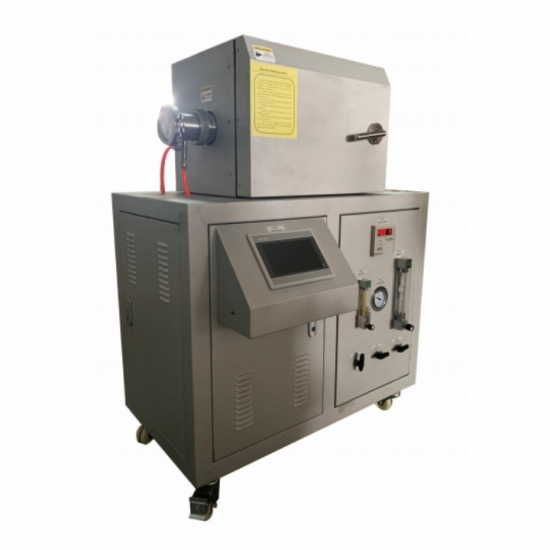
Microwave Furnace
Applications include:
* Sintering advanced ceramics (Al₂O₃, SiC, ZrO₂)
* Pre-sintering and debinding of molded components
* Heat treatment of metal powders
Lower processing temperatures and shorter sintering cycles improve efficiency and reduce grain growth.
Battery and Energy Materials
In lithium-ion, sodium-ion, and solid-state battery research, the furnace is used for:
* Calcining cathode materials
* Synthesizing solid electrolytes
* Carbonizing conductive additives
* Heating carbon foam, graphene, and composite materials
Uniform microwave heating improves electrochemical performance and consistency.
Chemical and Environmental Engineering
Microwave tube furnaces support processes such as:
* Pyrolysis of polymers and biomass
* Gas-solid reactions
* Removal of volatile components
* Waste conversion and material recycling
The technology offers faster reaction kinetics and reduced environmental impact.
4. Customizable Configurations
Manufacturers offer a wide range of options tailored to research or industrial needs:
Tube Materials
* Quartz for clean, low-temperature processes
* Alumina for high-temperature ceramics
* Silicon carbide for high-performance heating
Microwave Frequency and Power
Adjustable power levels and frequency options enable optimized heating for different material types.
Multi-Zone Temperature Control
Separate heating zones allow fine-tuning of thermal gradients along the tube.
Integration with Gas Flow Systems
Mass-flow controllers, gas purification units, and vacuum pumps can be included in custom setups.
Data Logging and Automation
Full digital control enables consistent, repeatable experimental and production cycles.
5. Conclusion
The microwave tube furnace represents a significant evolution in thermal processing technology, offering unmatched heating speed, uniformity, energy efficiency, and atmosphere control. Its ability to enhance material properties while reducing processing time makes it a valuable asset for modern laboratories and advanced manufacturing facilities. Whether used for nanomaterial synthesis, ceramic sintering, catalyst activation, or battery material development, the microwave tube furnace delivers superior performance and reliability. As industries continue to pursue higher efficiency and greater product quality, this advanced equipment will remain a core technology for precision material engineering.