Xiamen Tmax Battery Equipments Limited was set up as a manufacturer in 1995, dealing with Laboratory equipments, technology, etc. We have total manufacturing facilities of around 2, 000 square meters and more than 100 staff. Owning a group of experie-nced engineers and staffs, we can bring you not only reliable products and technology, but also excellent services and real value you will expect and enjoy.
Microwave Vertical Tube Furnace: High-Efficiency Thermal Processing for Advanced Material Applications
TheMicrowave Vertical Tube Furnace is an advanced thermal processing system that integrates high-frequency microwave heating with a vertically oriented tubular structure. Designed for high-purity material synthesis, rapid sintering, thermal decomposition, and controlled atmosphere reactions, this furnace has become an essential tool in laboratories, pilot-scale manufacturing, and high-tech industrial production. With its innovative vertical configuration and microwave heating principles, the microwave vertical tube furnace offers exceptional temperature uniformity, rapid heating rates, and superior energy efficiency compared with traditional resistance furnaces.
1. Overview and Heating Principle
Unlike conventional furnaces that transfer heat through conduction or convection, themicrowave vertical tube furnace generates heat internally within the material using electromagnetic microwave energy. When microwaves interact with microwave-absorbing materials, molecular friction and dipole rotation create instantaneous heat from the inside out. This volumetric heating mechanism leads to:
*Significantly shorter processing cycles
*Highly uniform temperature distribution
*Improved thermal efficiency
*Lower operational energy consumption
The vertical tube structure further enhances temperature uniformity by facilitating natural airflow, reducing thermal gradients, and ensuring consistent material exposure within the heating zone.
2. Structural Features and System Components
A modernmicrowave vertical tube furnace is composed of several precision-engineered components designed to deliver stable, reliable, and safe operation:
● Vertical Quartz or Ceramic Tube
The furnace tube is typically made of quartz, alumina, or other microwave-transparent materials. The vertical orientation allows easy loading of powders, substrates, rods, or crucibles, while minimizing contamination and ensuring uniform microwave penetration.
● High-Power Microwave Generator
Equipped with magnetron or solid-state microwave generators (commonly 2.45 GHz), the furnace delivers stable microwave energy with adjustable power levels. This ensures flexible heating control for various thermal treatment processes.
● High-Temperature Insulation Chamber
Multiple layers of thermal insulation help maintain stable internal temperatures while preventing heat loss. Microwave-absorbing insulation materials also ensure safe and efficient heating.
● Controlled Atmosphere and Vacuum Compatibility
Many models support vacuum operation and gas atmospheres such asargon, nitrogen, hydrogen, oxygen, or mixed gas environments. This capability enables advanced applications involving oxidation, reduction, carbonization, or inert atmosphere processing.
● Intelligent Temperature and Power Control System
PID temperature controllers, pyrometers, infrared sensors, and microwave feedback regulation allow precise control over temperature, heating rate, and power output. This ensures highly repeatable thermal profiles essential for scientific research and small-scale production.
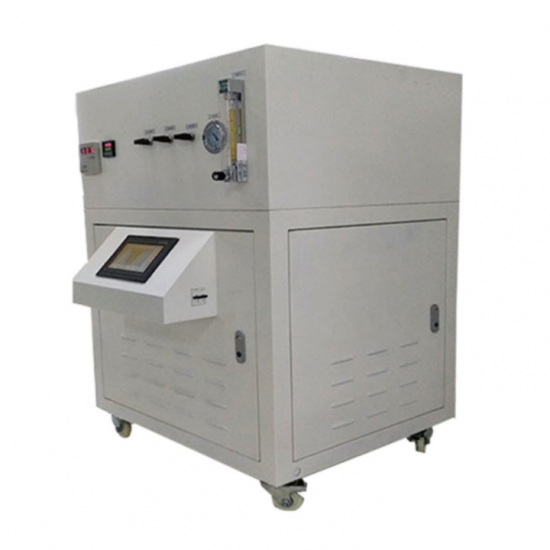
Microwave Tube Furnace
3. Key Advantages of the Microwave Vertical Tube Furnace
Themicrowave vertical tube furnace offers multiple performance benefits over traditional horizontal and resistance furnaces:
1. Rapid Heating and Short Processing Time
Microwave volumetric heating can increase temperatures quickly, reducing sintering or calcination cycle times by 30–70%.
2. Enhanced Temperature Uniformity
Vertical geometry and microwave energy penetration minimize thermal gradients, improving material consistency and microstructural quality.
3. Energy-Efficient Operation
Because heat is generated within the material rather than externally, overall energy consumption is substantially reduced.
4. Versatile Material Compatibility
The vertical tube design is ideal for powders, thin films, rods, ceramic samples, and functional materials requiring controlled heating.
5. Clean and Controlled Atmosphere Options
Compatibility with vacuum and inert gases ensures high-purity thermal processing without unwanted reactions or contamination.
6. Compact Footprint and Easy Maintenance
Vertical configuration reduces floor space usage and simplifies sample introduction, making the furnace suitable for laboratory or pilot-scale environments.
4. Industrial and Research Applications
Themicrowave vertical tube furnace serves a wide range of industries and research fields due to its precision, efficiency, and flexibility:
*Battery Materials: Calcination of cathode/anode materials, precursor decomposition, and conductive additive modification
*Advanced Ceramics: Sintering of nano-ceramics, functional ceramics, and dielectric materials
*Semiconductors: Annealing, oxidation, crystal growth, and defect reduction
*Metal Powders: Reduction, activation, and controlled thermal treatment of metal oxides and alloys
*Carbon Materials: Carbonization, graphitization, and surface modification of carbon-based composites
*Catalysts: Rapid catalyst precursor activation and regeneration processes
*Laboratory Research: Heat treatment for experimental materials requiring precise thermal control
5. Conclusion
TheMicrowave Vertical Tube Furnace represents a cutting-edge solution for high-efficiency, high-precision thermal processing. Its combination of microwave volumetric heating, vertical structural advantages, and atmosphere control makes it ideal for advanced material development, energy storage research, semiconductor processing, and specialty ceramics. As industries demand faster, cleaner, and more energy-efficient heating technologies, the microwave vertical tube furnace will continue to play a crucial role in next-generation material innovation and laboratory research.