Xiamen Tmax Battery Equipments Limited was set up as a manufacturer in 1995, dealing with Laboratory equipments, technology, etc. We have total manufacturing facilities of around 2, 000 square meters and more than 100 staff. Owning a group of experie-nced engineers and staffs, we can bring you not only reliable products and technology, but also excellent services and real value you will expect and enjoy.
DC Sputtering Coater: Advanced Thin-Film Deposition Equipment for Precision Applications
Overview
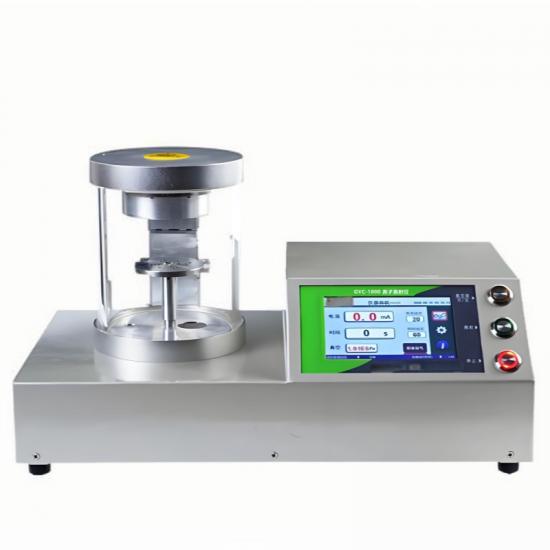
A DC Sputtering Coater is a specialized vacuum-based deposition machine designed for producing uniform, high-quality thin films on a variety of substrates. Based on the direct current (DC) sputtering principle, this equipment uses ionized gas to eject atoms from a solid target material and deposit them onto the substrate surface. DC sputtering is particularly suitable for conductive materials, offering precise control over film thickness, composition, and adhesion. Due to its reliability, simplicity, and versatility, DC sputtering coaters are widely employed in materials science, electronics, optics, and surface engineering, serving both research laboratories and industrial production lines.
Key Features
Modern DC sputtering coaters are engineered with robust mechanical structures and advanced electronic control systems. A high-vacuum chamber ensures minimal contamination and high-purity deposition. Most systems feature efficient pumping setups, including rotary and turbomolecular pumps, to achieve the required vacuum levels.
DC sputtering coaters are equipped with stable power supplies that provide consistent direct current to the target, enabling controlled ionization and precise material ejection. User-friendly interfaces, often featuring PLC or touchscreen controls, allow operators to adjust parameters such as sputtering voltage, current, deposition time, and chamber pressure. Additional features, such as substrate rotation, multi-sample holders, and target exchange mechanisms, enhance film uniformity, throughput, and operational flexibility.
Working Principle and Coating Process
The DC sputtering process begins by placing the substrates inside the vacuum chamber and evacuating it to the desired base pressure. An inert gas, commonly argon, is introduced into the chamber at controlled flow rates. Once the DC power is applied, the argon gas is ionized, forming a stable plasma.
Positively charged argon ions are accelerated toward the negatively biased conductive target, causing atoms to be physically ejected from the target surface. These atoms travel through the vacuum and condense onto the substrate, forming a thin, uniform, and adherent coating. By adjusting the sputtering current, voltage, target-to-substrate distance, and deposition time, the DC sputtering coater can achieve precise control over film thickness, microstructure, and surface morphology. Typical coating thicknesses range from a few nanometers to several micrometers, depending on application requirements.
DC sputtering
Applications
DC Sputtering Coaters are extensively used across a variety of scientific and industrial fields. In electronics and semiconductor industries, they are employed to deposit metal interconnects, conductive layers, and contact films on wafers and micro-components. In optics, DC sputtering is applied to create reflective and protective coatings on lenses, mirrors, and optical devices.
The equipment is also used in materials research for studying surface modification, thin-film growth, and functional coatings. Additionally, DC sputtering coaters are widely applied in the fabrication of sensors, MEMS devices, magnetic storage media, and energy-related components such as thin-film batteries and fuel cell electrodes.
Advantages
One of the primary advantages of a DC sputtering coater is its ability to produce highly uniform and adherent films with excellent density and mechanical stability. The process is clean and environmentally friendly, operating under a controlled vacuum environment that minimizes contamination.
DC sputtering offers precise control over deposition parameters, ensuring repeatable results for both experimental and production applications. It is particularly effective for coating conductive materials, providing strong adhesion and excellent surface coverage. Additional benefits include fast deposition rates, compatibility with various substrate types, and scalability for batch or continuous processing.
Conclusion
In summary, the DC Sputtering Coater is a versatile and reliable thin-film deposition system essential for modern research and industrial applications. Its precise process control, uniform coating capabilities, and wide applicability make it a cornerstone technology in electronics, optics, materials science, and surface engineering. By enabling high-quality, reproducible coatings, the DC sputtering coater continues to support innovation and precision manufacturing across multiple high-tech industries.